How Long Does Vinyl Siding Last? Lifespan, Maintenance & Replacement Signs
Quick answer: Vinyl siding lasts about 20 to 40 years. Where your house lands in that range depends less on the brand on the box and more on panel thickness, how the panels were hung, and how much sun and freeze-thaw the wall takes. In the Hudson Valley, we regularly open up 1990s vinyl that still has 10 good years left, and we also pull 12-year-old panels that were nailed too tight and buckled their way into an early replacement.
We install and replace siding on homes across Poughkeepsie, Wappingers Falls, Beacon, Hyde Park, and East Fishkill, and most of what shortens a vinyl lifespan around here is visible from a ladder in the first ten minutes. Below is what we see on real walls, not manufacturer marketing.
On This Page
- How long vinyl siding actually lasts
- What decides 20 years versus 40
- How to tell how old your siding is
- Maintenance that actually adds years
- What a lifetime warranty really covers
- Replacement signs specific to vinyl
- Repair, partial replacement, or full re-side
- Talk to a Hudson Valley siding crew
- Vinyl siding lifespan FAQs
How long vinyl siding actually lasts
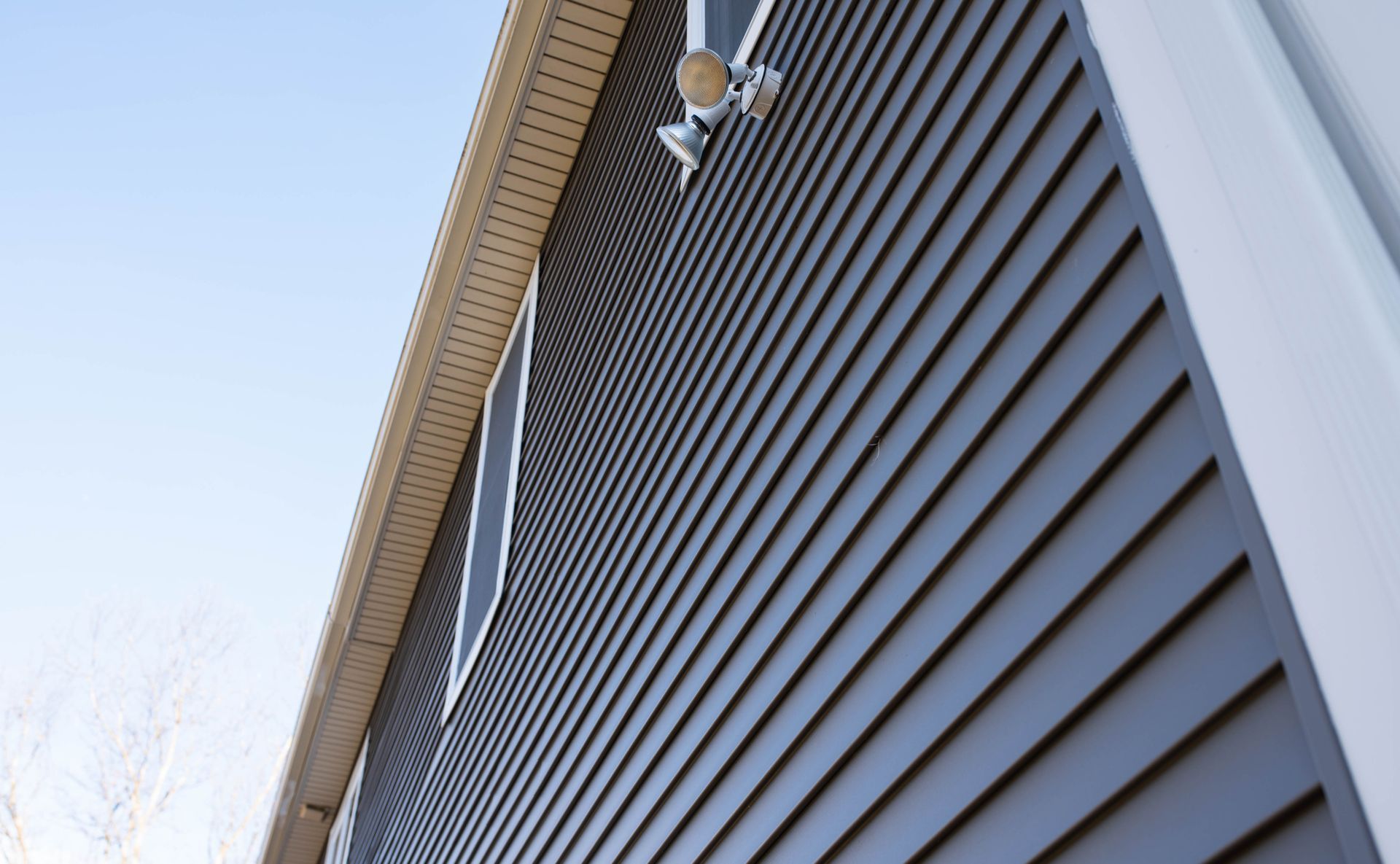
The 20 to 40 year range you see everywhere is real, but it is an average across the whole country. Thickness is the single best predictor of where a specific wall lands, because thicker panels resist the wind flex and impact cracking that kill vinyl long before the color gives out.
Vinyl panel thickness is measured in inches, and the difference between builder grade and premium is a few thousandths. That sounds trivial until a branch comes down in a February storm and one wall cracks while the other dents and springs back.
| Panel grade and thickness | Realistic lifespan on a Hudson Valley home | What usually fails first |
|---|---|---|
| Builder grade, around 0.040 in | 15 to 25 years | Cracking at corners and around windows, visible wall waviness |
| Standard residential, 0.042 to 0.044 in | 20 to 30 years | Fading on south and west walls, loose panels after wind events |
| Premium or insulated, 0.046 in and up | 30 to 40 years | Fading and accessory failure at J-channel and trim before the field panels |
Two clarifications homeowners ask about. Fading is a cosmetic clock, not a structural one, so faded siding is often still watertight. Brittleness is the structural clock, and it is what makes a 30-year-old wall crack when you lean a ladder on it.
Does vinyl outlast the house it hides?
Sometimes, and that is the problem. A wall can look fine while the sheathing behind it rots, which is why we press on panels and check trim before quoting anything. If you want the visible side of that story, our guide to
the signs your siding is failing before it gets expensive walks through the eight we find most often.
What decides 20 years versus 40
Four things move the number, and only one of them is the product you picked.
Installation, which matters more than the brand
Vinyl expands and contracts with temperature. A 12-foot panel can move roughly a quarter inch between a January morning and a July afternoon, so panels are designed to hang loosely and slide. They are not meant to be pinned to the wall.
When an installer drives the nail tight to the nailing hem, the panel cannot move, so it buckles in the first hot stretch. That wavy, oil-canned look on a newer wall is almost never a defective product. It is a fastening problem, and it shortens the life of every panel on that elevation.
The other version we see is face-nailing, where someone drives a nail straight through the panel face to hold down a loose piece. It holds for a season, then the hole becomes a crack, and the crack becomes a water path behind the panel.
Sun exposure and color choice
South and west walls fade first, and darker colors fade faster and move more. Deep blues, charcoals, and near-blacks have gotten popular on Hudson Valley colonials, and they look sharp, but they need tighter attention to expansion detail because they run hotter.
North walls have the opposite problem. Under the mature oak and maple canopy common in Pleasant Valley, LaGrangeville, and the older Poughkeepsie neighborhoods, north elevations stay damp and grow mildew that people mistake for permanent staining.
Reflected heat from low-E windows
This one surprises people. Vinyl starts to soften and distort at roughly 165 degrees Fahrenheit, and a double-pane low-E window can bounce a focused beam that reaches well over 200 degrees onto a nearby wall. The outer pane flexes slightly concave, which turns the glass into a lens.
It is worst at low sun angles, meaning late fall, winter, and early spring, and it often comes from a neighbor's window rather than your own. Manufacturers have caught up to it, and most vinyl warranties now exclude heat damage from window reflections. If a single patch of siding is warped while everything around it is perfect, look for glass across the yard before you blame the panels.
Freeze-thaw and winter impact
Vinyl gets stiff in the cold. A snow shovel bump, a ladder foot, or a chunk of ice off the roofline that would leave a scuff in July will split a panel in January, and our winters give the material plenty of chances.
Repeated freeze-thaw also finds every gap in the water-management layer behind the siding. That is the same mechanism we cover in
the most common causes of roof leaks, and on a siding job it usually shows up at roof-to-wall intersections where a kickout flashing was never installed.
How to tell how old your siding is
You cannot judge vinyl age by looking at it, because a well-shaded 1998 install can look newer than a sun-blasted 2012 one. Three ways to actually date it:
- Check the back of a panel. Manufacturers stamp a product name and a date or batch code on the reverse side or inside the nailing hem. Pull one piece from a low, hidden spot such as behind a downspout or at an inside corner.
- Pull the permit history. Your town or county building department will usually have a record of a full re-side, which also tells you whether the work was inspected.
- Look at what is underneath. If the vinyl went over original wood clapboard with no furring strips, that dates the job to a common 1980s and 1990s practice, and it is worth checking for trapped moisture.
If the panels date to the 1990s and still look straight and tight, you are likely in the last third of their service life. That is the point to start budgeting rather than reacting.
Maintenance that actually adds years
Vinyl is low maintenance, not no maintenance, and the small stuff genuinely buys time. Here is the cadence that works in our climate:
- Spring wash. Rinse with a garden hose and a soft-bristle brush after pollen season. Work bottom to top, rinse top to bottom, and stay away from high-PSI pressure washing, which drives water behind panels and can void your warranty.
- Treat mildew on shaded walls. North elevations under tree cover need a mild cleaning solution rather than scrubbing, which burnishes and dulls the finish.
- Keep heat sources away. Grills belong well off the wall, and fire pits should sit at least 15 feet from the house. Vinyl softens long before it burns.
- Trim back what touches the wall. Branches and shrubs abrade panels in wind and hold moisture against them.
- Walk the wall each fall. Look for loose panels, cracked J-channel, and gaps where caulk has pulled away at penetrations like hose bibs and dryer vents.
- Clear the gutters above it. Overflowing gutters dump water down the wall and behind the siding all winter. Our breakdown of seamless versus sectional gutters explains why the seam count matters for that, and the same fall checklist we use for preparing a roof for winter covers the roofline side.
What a lifetime warranty really covers
Vinyl siding is usually sold with a lifetime limited warranty, and the fine print is where the expectations break. "Lifetime" typically means 50 years, full coverage applies only to the original owner, and the money is heavily prorated after the first several years. Some brands hold non-prorated coverage for the first 10 years and then decline from there.
Ask these before you sign anything:
- Is it prorated, and starting when? A prorated claim at year 22 pays a fraction of replacement cost.
- Does it transfer, and what is the deadline? Transfers commonly require written notice within 30 to 90 days of the sale, and missing that window kills it.
- Does fade coverage transfer? Often it does not, even when the rest of the warranty does. Fade limits are written as a specific color-change threshold, not "looks faded to me."
- Is labor included? Material-only coverage means you pay a crew to install free panels.
- What voids it? Painting the panels, pressure washing above the recommended pressure, incompatible accessories from another brand, and installation that departs from the manufacturer's instructions.
- Is there a separate workmanship warranty? The manufacturer covers the product. Your installer covers the install, and the install is what fails more often.
That last point is the practical one. A 50-year product warranty on a wall that was nailed tight is worth very little.
Replacement signs specific to vinyl
Some of these are cosmetic and some mean water is already moving. The vinyl-specific ones we act on:
- Panels that crack when touched. Brittleness means the plasticizers are spent. Replacing single panels stops being practical because the neighbors crack as you work.
- Widespread buckling or waviness across a full elevation. Usually a fastening problem, and it does not settle back down.
- Warping in a defined patch. Look for a reflective window or a heat source before assuming panel failure.
- Chalky residue on your hand. The surface is breaking down, which is a late-stage fade sign.
- Loose or rattling panels after wind. The locking leg or the nailing hem has let go, and wind-driven rain follows.
- Soft trim or spongy spots when you press. That is sheathing damage behind the wall, not a siding issue, and new panels over it would hide the real problem.
- Panels you cannot match. Discontinued profiles and faded colors make partial repairs look patched.
Multiple signs on multiple walls points to replacement. One sign in one spot usually does not.
Repair, partial replacement, or full re-side
The decision comes down to how far through its service life the wall is, and whether the failure is isolated or systemic.
Repair usually makes sense when the damage is one or two panels, the siding is less than two-thirds through its expected life, matching stock is still available, and the cause is identifiable, like a single impact or one bad flashing detail.
Full replacement usually wins when the panels are brittle, the buckling covers a whole elevation, you are finding rot at the sheathing, matching panels are gone, or repair calls are becoming a yearly line item.
For budgeting, installed vinyl in our market generally runs about $3 to $12 per square foot depending on grade and complexity, with builder grade at the low end and premium or insulated panels at the high end. Tearing off old siding and hauling it away commonly adds somewhere in the $1,000 to $3,000 range, and any rot repair found underneath is priced after we can see it. A site visit is the only way to get a real number, since corner count, window count, and second-story access move labor more than most people expect.
If you are weighing materials rather than just timing, our
vinyl siding installation page lays out how vinyl compares with fiber cement, engineered wood, and cedar on a Hudson Valley home.
Talk to a Hudson Valley siding crew
If you are not sure whether your siding has years left or is on borrowed time, the fastest answer is a set of eyes on the wall. We will tell you which it is, including when the answer is that you should wait.
Call ADR Precision Builders at (914) 705-2045 or
request an estimate and we will take a look at the panels, the trim, and what is happening behind them. You can also see
recent exterior projects from Beacon, Beekman, Wappingers Falls, and Hopewell Junction to get a sense of how we finish a job.
Frequently Asked Questions
How long does vinyl siding last in New York?
Plan on 20 to 40 years, with most Hudson Valley homes landing in the 25 to 35 range. Our freeze-thaw cycles and winter impact risk pull the low end down on thin builder-grade panels, while thicker premium panels on a protected elevation can reach 40.
Can vinyl siding last 50 years?
Occasionally, yes. We still find serviceable panels from the early 1980s, usually on shaded walls with premium-thickness vinyl and a clean install. The finish will look dated and faded long before it stops shedding water, and matching a repair panel at that age is nearly impossible.
Is it worth replacing vinyl siding that is only faded?
Not on its own, if the panels are still flexible and tight. Faded siding is a curb-appeal decision, not a performance one. The exception is chalking, which signals the surface is breaking down and often shows up alongside brittleness.
Can you install new vinyl siding over old siding?
It is possible, and we usually advise against it. Layering hides the sheathing you most need to inspect, adds thickness that complicates window and door trim, and traps moisture if the old layer holds water. We would rather tear off, look at the substrate, correct the water barrier, and install on a known-good wall.
Does new siding void my old warranty?
The old warranty ends with the old siding. What matters is registering the new product correctly, keeping your receipts and installation date, and getting the workmanship coverage in writing from whoever does the install.